Some Grief Are For Export!
- Kooks de Leon
- May 12, 2025
- 7 min read
Updated: May 12, 2025
NOTE: THE POST THAT KEPT PEOPLE UP - YOURS TRULY, INCLUDED.
This book review (or let’s be honest, literary autopsy) gained traction fast when I first shared it on Facebook. It hit nearly 70,000 views, earned 231 shares, and even caught the attention of veteran columnist Rigoberto Tiglao, who shared it on his page with the caption: “No theatrics. Just clarity. Another solid one from Kooks.”
Not bad for something I wrote after a sleepless night and a possibly accidental caffeine overdose.
I’m putting it here on my blog because social media is not a library... it forgets fast and misplaces context even faster. And this one needs context. It needs a quiet room. A long sit. A reader who isn’t scrolling.
This wasn’t written to cancel. Or to clap back. It was written by someone who has lived through the headlines. Someone who’s tired of being talked about but rarely talked with.
So here it is. Unedited, still pissed off, still processing. Read it if you're ready to hear from someone who survived what others turned into prose.
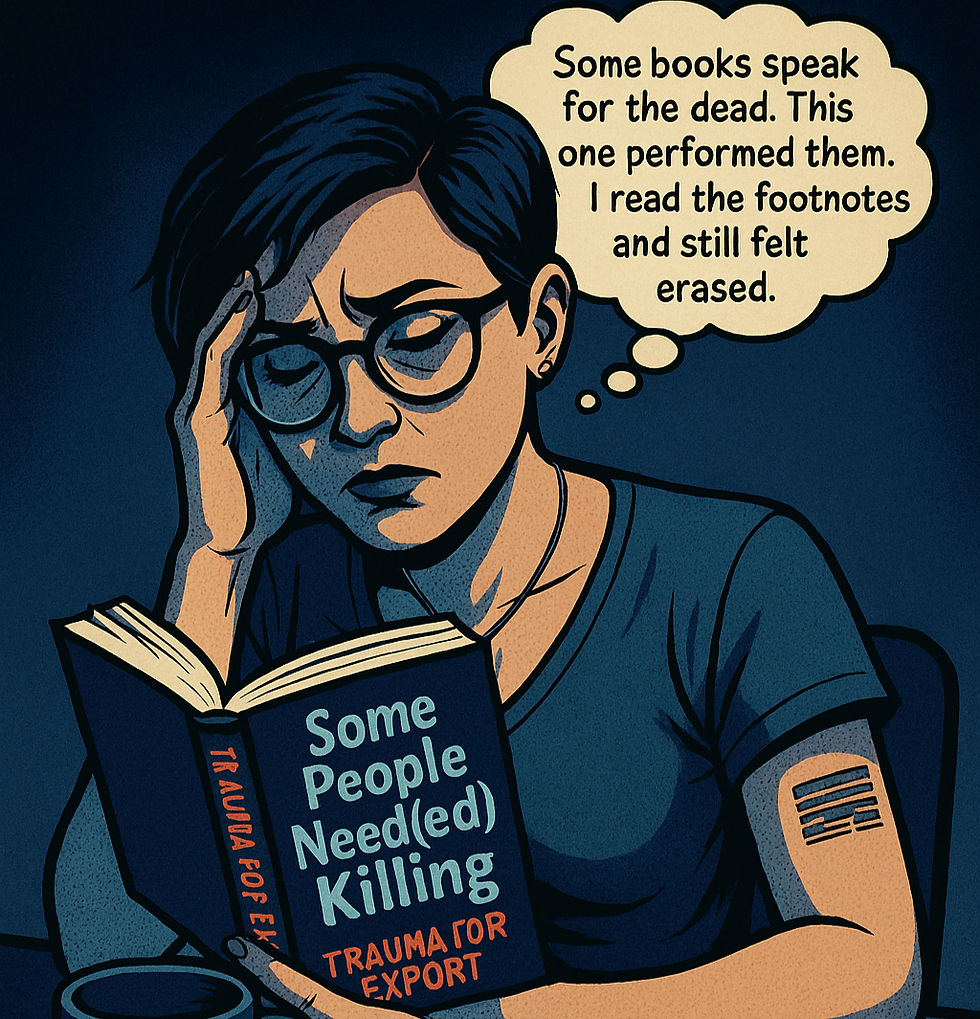
Still no sleep. Blame the book.
Just finished Some People Need(ed) Killing by Patricia Evangelista. I should’ve stopped at Chapter 2 but no. I kept going like a nosy neighbor who heard screaming next door. Thought it would be medicine. Maybe even healing.
Turned out it was theater.
I didn’t even mean to read it the other day. Was planning to re-read Dogeaters by Jessica Hagedorn. I wanted to see Imperial Manila in all her ugly glory again—felt right, given the state of things politically.
Then I remembered Sass Rogando Sasot post about Patricia Evangelista’s book. Morbid curiosity kicked in. Add a Book Pusher’s impulse and, of course, I bought the eBook.
Instant regret.
I opened it the way I open any book I’m suspicious of—slowly, like checking under the sink for cockroaches. One chapter turned into two. Then three.
Next thing I knew, it was 1PM. Body clock said 1AM. I’m supposed to be asleep by 10AM.
But I couldn’t. I was restless. Like my chest had been used as a stage and something heavy had just finished performing.
I’m not shocked by the violence. That’s the sad part. That part of me’s dead already. It’s the TONE that haunts me. The way the grief is... packaged. Polished. Primed for export. I’ve seen real grief. It’s not this neat.
It’s like watching someone deliver a eulogy in a language the corpse never spoke. Worse, it’s like watching them give that eulogy to an audience that only showed up for the hors d'oeuvres.
Somewhere in Chapter 3, Mascot for Hope, it hit me. That line: "When I was little... I wanted to be blond, blue-eyed, and white." Said with the earnestness of a TED Talk. Honest? Maybe. Raw? Sure. But why there?
The book opens with a girl named Love-Love. Her father’s last word—"Love"—was spoken just before a bullet tore through his head one August night. Patricia had just written: "I know only a few dozen of the dead by name. It doesn't matter to the president. He has enough names for them all. They're addicts, pushers... madmen. Love-Love can name two of them. They are Dee and Ma."
Then comes that line about wanting to be white.
In a book about murder, broken mothers, bleeding alleys, vigilantes, children carrying trauma like second skin, and a president who said, “Kill the criminals. Period.”
It clanged like a fork hitting a church bell!
That wasn’t a memory. That was a flag. A bright, shiny “Look at me, I understand the Western gaze” kind of flag. It felt like she wasn’t grieving with the country... she was grieving on its behalf, then shipping it off for processing. For export.
This book wasn’t talking to me. It was talking to Uncle Sam. It read like a long, impassioned breakup letter.
“Dear America, We were colonized, then traumatized. Now look what happened. Love me anyway.”
I’ve read enough of these to spot the pattern. A kind of psychological rerouting. When the pain at home doesn’t get heard, people start aiming their stories up. In Patricia's case, toward people with visas, grants, good teeth. It’s not evil. It’s just... tragic. The applause becomes the therapy. And eventually, the addiction.
I know this because I do it too. I sell my labor to the West. I offer my expertise to Western markets. I turn challenges into deliverables. I neutralize the tone. I keep the presentation polished and forward-facing.
But at least I’m honest about it. This book pretends it's healing. But it’s not.
As a bibliotherapist (I like to call myself Book Pusher) I crack books open like pills. I want to know what they treat. What symptoms they soothe. Who they’re safe for. And who they might quietly harm.
This one? Feels like a drug that makes you cry beautifully in public but leaves you with a headache in private. Feels like a sedative for guilt, not grief.
Who is it for, really?
• White guilt tourists in Southeast Asia
• Journalists who still believe their words alone are gospel and therefore can save lives
• Ex-journos who feel bad for quitting and desperately wants to feel relevant again
• Grad students writing theses on “Postcolonial Sadness”
• Sad girls and boys who want to be sadder
• People who like being scolded in good English
• People who hate Duterte but want to sound intelligent while doing it
• People who, to this day, still can’t accept that the man they call a killer made it to the ballot—and won by a landslide
It’s not for people who saw their husbands put down the foil. Or mothers who slept easier during the drug war. Or neighbors who finally stopped hearing screams through the walls. Or anyone whose story didn’t end in blood.
The book pretends those people don’t exist. Or maybe they’re just inconvenient. No climax. No punchline. No Pulitzer. Just boring survival.
That’s what appalled me the most—the absence of that angle. No contrast to throw light on the pitch-black portrait of the Philippines, of the Pinoys, of Duterte that the book painted.
It’s strange. Patricia goes out of her way to unpack language. She breaks down the word “beautiful”—how we use it, how Duterte used it. Even adds a note at the end apologizing for how some words lose their weight in translation. But she never explains the all the parts of the country that didn’t fall apart under Duterte. The places that felt safer. The people who didn’t cheer or scream—just quietly felt... relief.
That kind of silence speaks louder than the prose.
Oh, and the way the book sounds! Jesus! Like one long, elegant trauma dump at a Geneva panel. Polished. Composed. Just the right tremble in the voice to draw sympathy but never too raw, never too local. There are moments where it feels like she’s speaking for us, not with us. As if she’s telling foreigners, “We’re not all savages. We just made a bad choice. Please understand.”
And I get it. I do. I’ve done versions of that speech in emails. In Zoom calls. When you grow up brown and broke and colonized, explaining yourself becomes second nature. You learn to translate pain into something palatable. Something quotable. Something you can say without choking.
But here? In a book about murder? About children in coffins? About a lanky epileptic drug addict gunned down? You don’t deliver those lines like a diplomat.
That’s what stuck. It wasn’t the voice of someone from here. It was the voice of someone representing us. A self-appointed ambassador of the broken. Or maybe just the Mascot of Hope...?
God, that phrase. It doesn’t even sound like a title. It sounds like a UNICEF role play!
I don’t blame her. Not really. But I don’t trust it either.
Because what happens when you turn national grief into a performance? When death becomes the backdrop for a career? When the pain is packaged for export and sold as moral currency? You get applause. You get awards. Maybe a 'Oh, you poor thing!' here and a Pulitzer prize for your pain and suffering there.
But you lose us.
And the more I read, the more I felt like I was being ignored in my own house. The weirdest part? I didn’t even feel anger. Just... distance. Like watching a stranger describe my relative’s funeral while standing on a podium. And somehow, everyone’s clapping.
I needed this book to do something else. I needed it to hold the mess. To say the unsayable. To sit with the parts we don’t show in grants or essays or panels.
Instead, I got stage lighting. A grief so edited it stopped feeling like grief. And maybe that’s what this book cures. Or pretends to.
Might help with:
• Performative empathy
• Chronic thesis nostalgia
• Western guilt management
• That special kind of moral high horse only found in footnotes.
• That polished tone people use when they want to sound smart and better than you.
Might cause:
• Survivor’s guilt (especially if someone you love lived)
• Headaches from over-sanitized pain
• Sudden, violent distrust of TED Talks
• Existential eczema
Final diagnosis?
• Therapy for the audience. Not the subject.
• Fluency in trauma. But not in recovery.
And definitely not written for those who stayed, suffered, survived—and don’t have the luxury of metaphors or the illusion that vigilantes and soulless cops only showed up when the “killer” made it to the ballot.
But if you ever wished you had blue eyes... oh, you’ll cry harder. And you’ll love this book to death.
I should sleep. I won’t. But I should.
—Kooks de Leon, Book Pusher's (Bibliotherapist's) Diary, 03 Apr 2025 | 3:04 PM
P.S. We Are Duterte (the title of the book’s Epilogue) still sounds like a badass metal band. Patricia probably hears it like a psycho killer’s final line before the screen fades to black.
P.P.S. I know export work when I see it. I write emails for dollars. I smile for dollars. I swallow my opinions also for dollars. This wasn’t written for pesos. It was written for applause and Western eyeballs.

Comments